
ERUS-EAUN26 report: Advancing robotic nursing through training and teamwork
Thirty-five nurses attended the 1-day ERUS-EAUN26 Robotic Nursing programme, held in parallel with ERUS26 in Padua (IT) in September. The plenary sessions and discussions focused on strengthening robotic surgery through workforce development, and structured training. The programme brought together experts and colleagues from across Europe to share practical experiences, innovative approaches and insights from clinical practice. In this report, we highlight some of the key sessions, discussions and additional learning activities that delegates took part in.
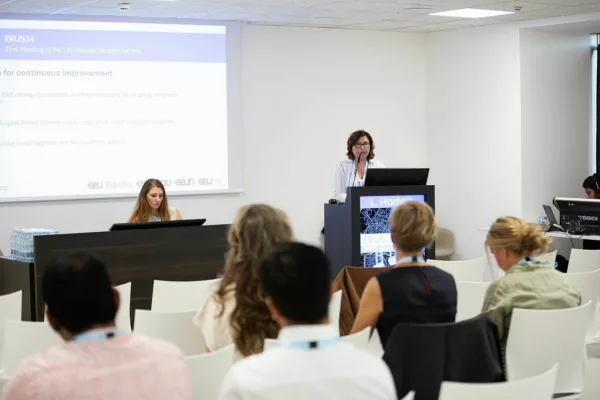
The first session, ‘Workforce, training and systems’, chaired by Ms. Marta Marchetti (GB) examined how structured training and improved operating room systems can support high-reliability robotic practice. This followed with Ms. Isabel Pantrigo Gundin (ES) introducing the concept of ‘Robotic Surgical Choreography (RSC)’.
Following this, Dr. Ruben De Groote (BE) discussed approaches to increasing usability and accuracy in the operating room, while Mrs. Luminita Hodea (GB) presented a structured model for implementing surgical education within a hospital setting.
Ms. Pamela Nwangwu (GB) explored home-based TWOC pathways and their potential to empower patients and support recovery. She also presented on individualised VTE risk stratification in robotic-assisted radical prostatectomy (RALP). On reviewing her lecture, she stated: “My presentation was about more than risk scores - it was about asking a simple but important question: Are we truly individualising care?”
According to Ms. Nwangwu, “Every RALP patient has a different risk profile, comorbidities, mobility, cancer-related factors and personal circumstances. A ‘one-size-fits-all’ approach may not always reflect the individual sitting in front of us. As nurses, we have an important role in assessment, recognising risk, challenging assumptions, and ensuring VTE prevention is personalised, evidence-based and centred around the individual patient.”
Bridging the gap: The importance of team training and education
Ms. Eeva Claasen and Ms. Marie H. Jernberg (SE) shared a presentation on Sweden’s national operating-room training programme. This national programme brings multidisciplinary teams together to strengthen professional development, facilitate knowledge exchange and build a national network - all with patient safety at its core. According to Ms. Marchetti, “It was particularly valuable to hear how technical knowledge, non-technical skills, case discussions and simulation (including emergency undocking) are integrated into the programme. This was a wonderful example of how structured team training can support safer, more coordinated surgical care. Congratulations on this excellent initiative!”
The final session of the day, ‘Pathways, innovation and service delivery’ looked towards future developments in robotic surgical education and practice. Dr. Nikoloas Liakos (DE) explored the role of simulation training. Ms. Marchetti presented survey findings on preparedness for emergency situations, and Prof. Ben Challacombe (GB) discussed the qualities and practical skills required of an effective robotic bedside assistant.
Poster presentations: Showcasing nursing research and innovations
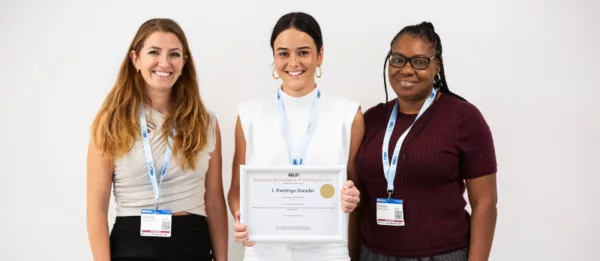
The top abstract submissions were selected for poster presentations. Ms. Pantrigo Gundin presented on her award-winning abstract, PEE08: ‘Robotic Surgical Choreography (RSC): The nurse-led pace protocol for process optimisation in robot-assisted radical prostatectomy’.
Following this, Dr. Nihat Karabacak (TR) presented on PEE05: ‘Self-management scale for lower urinary tract symptoms after radical prostatectomy: A Turkish validity and reliability study’.
Robotic emergency simulation drill in the ER
In addition to the 1-day nurses’ programme, Intuitive Surgical supported a robotic emergency simulation course designed for nurses, anesthetists, and surgeons. The experience offered an immersive, multidisciplinary learning experience based on real-world robotic surgical emergencies, with participants working together as one team. Through realistic scenarios, participants practised team decision-making and communication under pressure, followed by structured debriefings that allowed them to reflect on their performance and identify opportunities for improvement in a safe learning environment.
Ms. Nwangwu: “For me, the biggest takeaway was that robotic surgery is never just about the robot. It is about the people behind the technology - how we communicate, anticipate each other’s needs, manage challenges and work together as one team.”
“The multidisciplinary simulation was a great reminder that learning from colleagues with different skills and perspectives makes us better practitioners and, ultimately, helps us provide safer care for our patients. I came away feeling inspired, challenged and motivated to continue developing our own practice and to share this learning with colleagues within my team.”
From the participant feedback survey of the robotic emergency simulation, self-reported preparedness to manage a robotic emergency increased from 25% before the simulation to 63% following the course, with average confidence increasing from 3.0 to 3.94 out of 5. The majority of participants (94%) found the content realistic and relevant to clinical practice, while 94% rated the course as very good to excellent. Furthermore, 88% reported that the simulation provided them with a better understanding of teamwork and communication, and 88% felt that the learning was directly applicable to their clinical practice. The most frequently identified valuable element of the experience was communication, highlighting the importance of effective teamwork and human factors when managing robotic emergencies.
We would like to thank all those who contributed to making this hands-on robotic emergency simulation experience possible. In particular, we gratefully acknowledge INTUITIVE SURGICAL, whose financial support made the training possible. We would also like to thank SIMMED for supporting the quality and safety of the simulation, and SIMULKARE for their valuable contribution. Our thanks also go to the University Hospital of Padua, Prof. Fabrizio Dal Moro and his team, for their expertise, commitment and support in delivering the practical training experience.
Hands-on training in the Exhibition
The nursing programme was further complemented with an introduction to innovations and hands-on training on the Hugo RAS at Medtronic's stand in the exhibition. With thanks to Medtronic for making this possible.
Hospital Visit, and a journey through medical history
The day before the nurses’ meeting, a group of delegates visited the 'Padua University Hospital', one of Italy’s major teaching hospitals. An insightful lecture on “History of medicine in Padova to healthcare today” was presented by Prof. Fabio Zampieri. The visit also provided an opportunity to explore Padua’s rich medical history, including a visit to Palazzo Bo, the historic seat of the University of Padua. The university has a distinguished legacy in medicine, science and education, and Palazzo Bo is home to the world’s oldest surviving permanent anatomical theatre, the ‘Teatro Anatomico’, which dates back to 1594.
Online non-technical skills course
The meeting was further complemented by an online non-technical skills course developed by Prof. Mats Ericson from Karolinska Institute Innovation. We are particularly grateful to Prof. Ericson for his contribution to the organisation of the programme.
Delegate feedback
From the post-meeting survey, participants highlighted the value of learning how robotic urological surgery is approached in different countries, with discussions among international colleagues and live surgery sessions providing practical insights.
They also found it very useful to share experiences and discuss different approaches to robotic training and practice with colleagues from other countries. Several participants identified ideas they could take back to their own institutions, including approaches to training theatre staff who had not received formal robotic education, resources and pathways for introducing staff to robotic surgery, and educational initiatives to support teams working with the da Vinci Xi system.
The interactive discussion format was also valued for opening up new topics and opportunities for learning, demonstrating how sharing experiences across institutions can generate ideas that can be taken back and applied in clinical practice.
The programme provided insight into emergency protocols used in different hospitals, with participants noting plans to bring these approaches to their own practice and adapting them within their local settings.