
2. METHODOLOGY
The EAUN Guidelines Working Group for indwelling catheters have prepared this guideline document to help nurses assess the evidence-based management of catheter care, and to incorporate the guidelines’ recommendations into their clinical practice. These guidelines are not meant to be proscriptive, nor will adherence to these guidelines guarantee a successful outcome in all cases. Ultimately, decisions regarding care must be made on a case-by-case basis by healthcare professionals after consultation with their patients using their clinical judgement, knowledge and expertise.
The Expert Panel consists of a multidisciplinary team of nurse specialists and a urologist (see Chapter 17, About the authors). Job titles within the specialty differ among countries, and even within countries. To the purpose of this document, we refer to all nurses who are working with indwelling catheters as nurse specialists.
2.1 PICO questions
Prior to the literature search, PICO questions were formulated to help answer questions from practice with evidence. The individual PICO questions can be found in Appendix S.
However, hardly any PICO questions were answered by the literature. There is a need for research in this area because these issues are often costly and time-consuming and restrict the quality of life of catheter users. By answering relevant questions, the gap between practice and science can be increasingly narrowed.
2.2 Search keywords
Search terms:
- Urinary catheter
- Indwelling catheter (suprapubic and transurethral)
- Urinary tract infection
- Bacteriuria
- Hospital-acquired infection
- Quality of life
- Sexual (dys)function
Limit to:
- years: 2010 – current
- English language
Exclude:
- Children and adolescents
- Notes/editorials/letters/comments/news/opinions
- Case reports
- Abstracts
Remove:
- Duplicates
2.3 Literature search
The information offered in these guidelines was obtained through a systematic literature search and through review of current procedures undertaken in member countries of the EAUN. All group members participated in the critical assessment of the scientific papers identified. Bibliographical databases consulted included Embase, Medline, the Cochrane Library database CENTRAL, Cochrane Database of Systematic Reviews (CDSR) and Cinahl. The search was based on the keywords listed above. The question for which the references were searched was: “Is there any evidence for indwelling catheterisation for nursing interventions in different care situations such as preparation, insertion, or care of indwelling catheters as well as catheter materials or complications?” Both Embase and Medline were searched using both free text and the respective thesauri MeSH and Emtree. If a topic was not covered by the results of the search, earlier references were used.
Whenever possible, the Guidelines Working Group graded treatment recommendations using a three-grade system (A–C) and inserted levels of evidence to help readers assess the validity of the statements made. The aim of this practice was to ensure transparency between the underlying evidence and the recommendations given. This system is further described in Tables 1 and 2. (see Section 2.9)
2.4 Limitations of the search
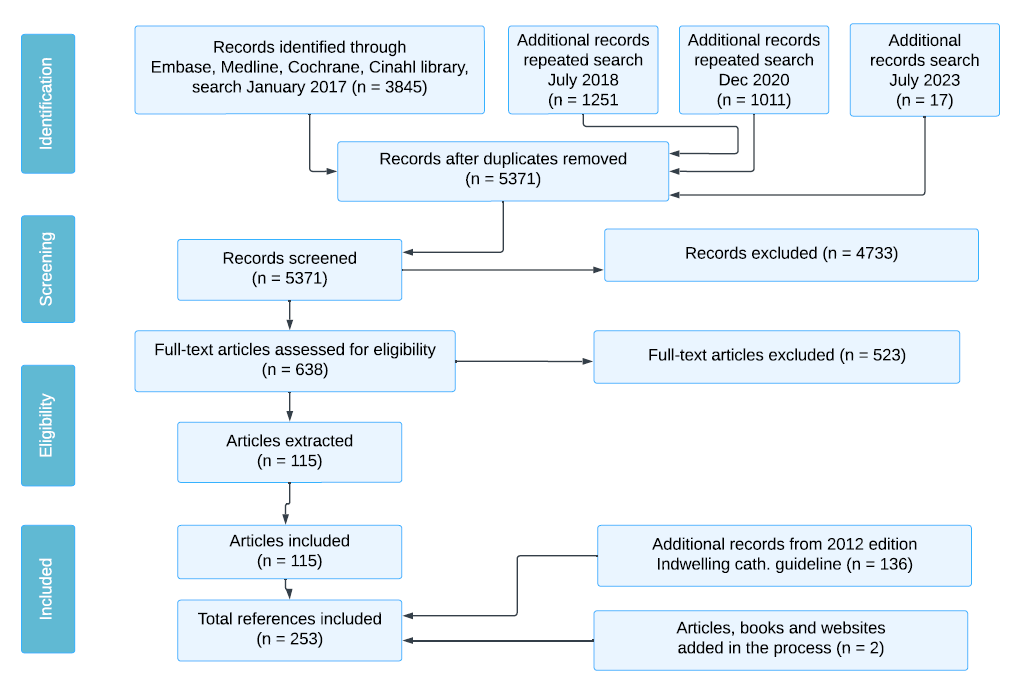
EAUN commissioned Yuhong Yuan, Department of Medicine, Hamilton Health Science Center, McMaster University, Hamilton, ON, Canada to do the search. The initial search was performed on 31 January 2017 and updated searches on 25 July 2018 and 7 December 2020. The search results from Medline, Embase, CENTRAL, CDSR and Cinahl were not limited to any type of study. In all databases, output was limited to human studies. In Embase, Medline and Cinahl output was limited to English language publications.
In 2023 an additional focussed search was performed in Medline for systematic reviews and meta-analysis from December 2020 - 15 July 2023.
2.5 Search results
The search resulted in 5371 abstracts from scientific publications. After reading the abstracts, 638 were left and full-text articles were made available to the Working Group. Of these, 115 articles were used in the guidelines. It was a policy decision to restrict the search in this way, though the group were aware that more complex strategies were possible and would be encouraged in the context of a formal systematic review. In the process of working with the articles, 2 new references were found and added to the reference list, that were relevant for the topic and cited in the text. 136 references from the previous version of these guidelines were retained.
The time frame covered by the referenced literature is 1976 to July 2023.
Diagram 1. PRISMA Flow diagram of the search
2.6 Expert nurse survey and discussion
In May 2021, several issues for which no clear evidence was found in the literature were surveyed with an online survey and the results were discussed in a consensus video meeting with a group of specialist nurses for better understanding of the survey answers and to seek consensus.
The survey confirmed there is a lot of difference in current nursing practice. In the consensus meeting, the authors were able to confirm the text in the current guideline regarding possible reasons and solutions for leakage, advice for encrustation, advise for sex with an indwelling catheter, instructions for catheter bag and valve replacement, and reasons and good practice for flushing a long-term catheter. These survey results and discussion support the recommendations with an evidence level 4, grade of recommendation C.
2.7 Limitations of the document
The EAUN acknowledges and accepts the limitations of this document. It must be emphasised that the current guidelines provide information about the treatment of individual patients according to standardised approach. The information should be considered as providing recommendations without legal implications. The intended readership is the pan-European practising urology nurse and nurses working in a related field. Cost-effectiveness considerations and non-clinical questions are best addressed locally and therefore fall outside the remit of these guidelines. Other stakeholders have not been involved in producing this document.
2.8 Review process
The Working Group included an extensive number of topics, which are not always only applicable to catheterisation, but decided to include them because they make the guidelines more complete. A blinded review was carried out by specialised nurses and urologists in several countries. To ensure high quality nurse reviewers from various countries, national urology nurses societies were invited to propose reviewers. The Working Group revised the document based on the comments received. A final version was approved by the EAUN Board and the EAU Executive member responsible for EAUN activities.
2.9 Rating system
The recommendations provided in these documents are based on a rating system (Table 1 and 2) modified from that produced by the Oxford Centre for Evidence-based Medicine. [2]
Some of the literature was not easy to grade. If, however, the EAUN Working Group thought that the information would be useful in practice, it was ranked with an evidence level 4, grade of recommendation C. Low level evidence indicates that no higher level was found in the literature when writing these guidelines, but cannot be regarded as an indication of the importance of the topic or recommendation for daily practice.
Table 1: Level of evidence (LE)
| LE | Type of evidence |
| 1a | Evidence obtained from meta-analysis of randomised trials |
| 1b | Evidence obtained fromat least one randomised trial |
| 2a | Evidence obtained from one well-designed controlled study without randomisation |
| 2b | Evidence obtained from at leastone other type of well-designed quasi-experimental study |
| 3 | Evidence obtained from well-designed non-experimental studies, such as comparative studies, correlation studies and case reports |
| 4 | Evidence obtained from expert committee reports or opinions or clinical experience of respected authorities |
Table 2: Grade of recommendation (GR)
| GR | Nature of recommendation |
| A | Based on clinical studies of good quality and consistency addressing the specific recommendation and including at least one randomised trial |
| B | Based on well-conducted clinical studies, but without randomised clinical trials |
| C | Made despite theabsence of directly applicable clinical studies of good quality |
The definition of evidence-basednursing according to Behrens 2004 is: “Integration of the latest, highest level scientific research into the daily nursing practice, with regard to theoretical knowledge, nursing experience, the ideas of the patient and available resources”. [3]
There are four components for nursing decisions:
- results of nursing science
- personal clinical experience of the nurse
- existing resources
- patient wishes. [4]
This definition makes clear that both the literature and the experience of nurses and patients are necessary for decision-making.